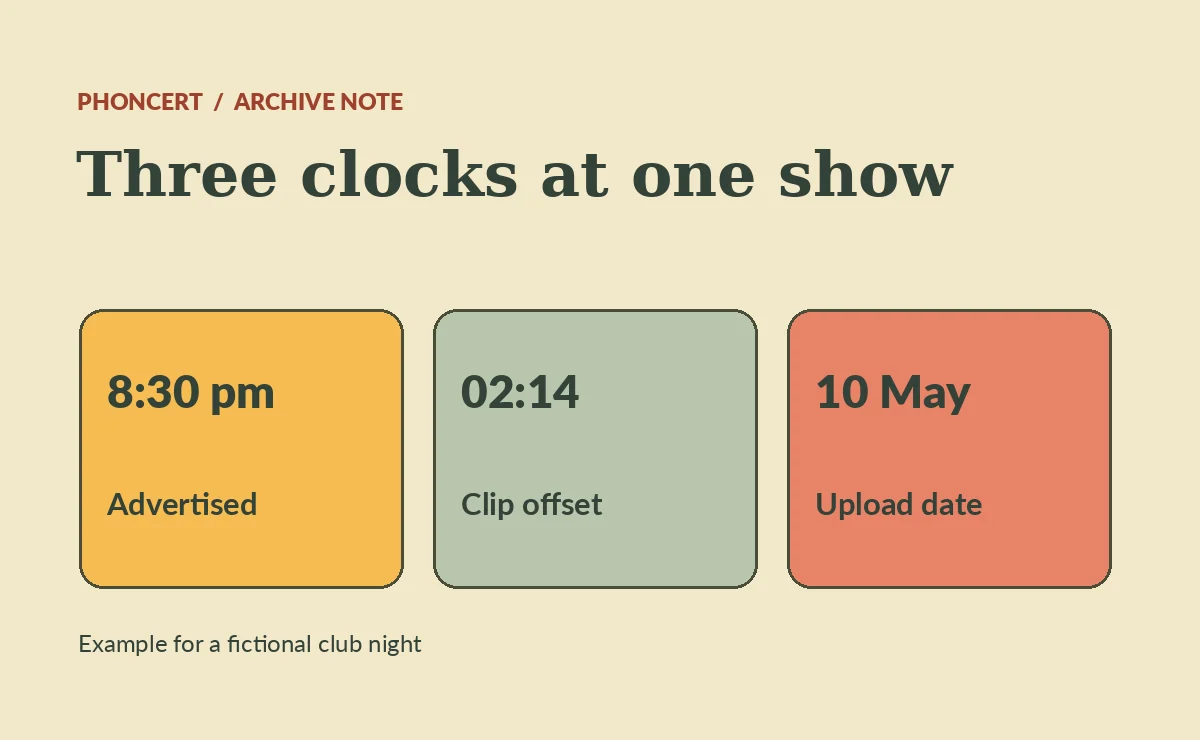
An advertised start, the opening of a set and the date a recording appeared online can all belong beside one concert. Give each time its own label so another reader can tell what the surviving source supports.
A small record with three clocks
Imagine a fictional club night on 8 May. A listing announces an 8:30 p.m. performance. A surviving clip is published on 10 May with a description that names the venue and date. At 02:14 in the clip, the band starts the song we want to identify. A bare entry reading “8 May, 8:30, 02:14, 10 May” has the raw information. A reader still has to guess which time came from which record.
A useful note would say “Advertised start 8:30 p.m. on 8 May, according to the venue listing”, then record the video’s upload date and where the song begins within the clip. Leave the actual set start open until a source states it. The clip may begin part-way through the performance.
Check what each source is describing
- Advertised event time
- Usually comes from a venue calendar, organiser listing or ticket page. Record whether the event page calls it doors or show time.
- Actual set time
- Use a dated source that identifies the time of the performance when you have one. A scheduled time remains useful under its own label.
- Media date and offset
- Record when a recording appeared and where a moment occurs in that media object. Keep the recording date separate if the uploader supplies it.
Schema.org makes a similar distinction in its vocabulary. It gives an event a start date and uses an upload date for a video object. If you copy these fields into an archive note, keep the source names beside them. Schema.org event start date and Schema.org video object fields.
Record the detail that might settle the next question
A dated venue notice can establish the advertised time even when the recording is missing. A surviving clip can establish which track appears in the clip even if it does not show the full set. Put the recorded observation first and keep one follow-up question visible, such as “Does the organiser’s later account give an actual stage time?”
Archive readers rarely need an exact minute for its own sake. They need to know whether two references can be joined. Labelling each clock makes that join easier to check.